
ANEW: Ali and Me
The Day the Champ arrived at school

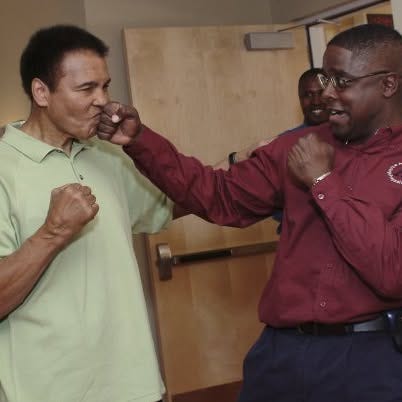
It was a fairly sleepy spring day in the Las Vegas Valley when he came. It could have been April or March. It certainly was not May. May days get filled too quickly with goodbyes and ceremonies, even in Vegas. So many people were out of the building that day. In the middle of campus, the school’s gymnasium was about to go up in what would be the heart of the campus at the Agassi School.
The blazing hot days were yet to come, and the blistering cold days were behind us. Don’t get fooled. Vegas can be awfully cold in the wintertime. There is nothing to keep the heat in. It was maybe in the 70s that day.
In other words, it was a day like any other day, except on this day, we would have a visitor to campus who would inspire us to do the work we were “born” to do. That last comment came from Stedman Graham, who had pulled me aside and asked a simple question of me, which was, “Is this the work you were born to do?”
I didn’t hesitate to think about it, and the answer came quickly, seemingly from the bottom of my feet, or even further than that, from some well beneath me, “Absolutely!” I could feel the bucket rise up at the surface when it arrived.
On this day, it wasn’t Stedman, but Ali who surprised us all with a visit. I believe I was at the guards’ station in the front when the black car came. It’s funny how memory for years before can come careening down a corridor, and I have it. But twenty years ago seems like a lifetime ago. Ali came to see us a lifetime ago. Truly, if I didn’t have the pictures, I would have thought it was a dream.
The Agassi Board of Directors was meeting, and the students were doing their thing in the classroom. One of the things they were known for, other than their crisp uniforms and citing the Agassi Code of Respect, was how well-behaved they were. They wore their discipline back then like a badge of honor. The teachers and other principals were “on it.” As usual, they looked great. Polished in their two-toned colors, khaki pants and maroon tops for the younger kids, and khaki pants and blue tops for the bigs.
How do you write about meeting a legend? One of the world’s most recognizable people. You describe the scene. The black sedan pulled up, and out popped the Champ, which is what his manager Bernie Yuman called him. “Hey, Champ, this way, Champ.” Yuman gave directions to Ali the way that we gave instructions to the Agassi students. That is what I first noticed.
I was part of his escort because Ali was meant to surprise and inspire another of the most recognizable humans on the planet — the man I technically worked for, Andre Agassi. Ali was coming on one of the rare Agassi Board of Directors’ meetings to rally the luminaries who sat on his Board. These were people who were not easily impressed. Plus, the students.
What I noticed more than anything is that the Champ’s Parkinson’s had progressed so much that he did have a hard time tracking things. Bernie Yuman had to constantly redirect him.
“Hey, Champ. This way, this way.” Or, “Hey, Champ, take a picture with this group.” Or, “Hey, Champ, come just a little bit to your left.”
Each and every time, Ali did. At one point, in the middle school math room, where the teacher had hung a picture of Ali — you know the one, where he is standing above Sonny Liston, telling him to get up — that picture that solidified Ali’s name for the history books. Ali gestured for a pen. It was a thick-lined Sharpie. In his shaking hands, he picked up the pen and with a flourish I would not forget, he signed his name as broad and big as day. His signature was as clear and as sharp as his mind totally was, locked inside a body that would give out years later, but not yet. Not that day. That day, the signature said everything the voice could no longer say easily. It was defiant. It was him.
The students cycled through to meet him in groups, their gray uniforms pressed and their eyes wide. These were kids who had seen hard things. Some of them had seen things that children should not have to see. And yet, in that room, with that man, they stood a little straighter. Nobody told them to. They just did. That is what a certain kind of presence does. It doesn’t ask anything of you. It simply raises the temperature of the room, and you rise to meet it.
I stood off to the side for most of it, which is where I preferred to be. I was not there to collect a moment. I was there to make sure the moment happened cleanly, that the students got what they needed, that the day ran the way it was supposed to run. But I will admit that when Bernie guided the Champ toward me for a photograph, I did not step back. I stood there. I let it happen. I am glad I did.
What I carry from that day is not the image of the legend, though the pictures remind me he was real and that it really happened. What I carry is the lesson hiding inside the whole afternoon, which is that greatness, true greatness, is almost always quieter up close than it looks from a distance. Ali shuffled. Ali needed guidance. Ali’s hands shook. And yet when he signed that poster, the room got very still, the way rooms get still when something true is happening.
Bernie called him Champ because that is what he was. Not was. Is. The body changes. The title does not.
We were all doing the work we were born to do that day. Stedman had asked me that question, and I had answered from somewhere deep. Ali answered it every single day, just by showing up. Even then. Even shuffling toward a math room in a school in the Las Vegas Valley on a forgettable spring afternoon that none of us who were there will ever quite forget.
#####
For even more pictures from the Ali visit to the Agassi School from April 7, 2005 in tomorrow’s special paid subscriber edition, redeem your special offer here →
Curated Listening:
Sam Cooke and Muhammad Ali were cut from the same cloth. They were both men who carried the weight of a generation with grace and refused to let the world define them on its own terms. Let this one play while you read. Listen to Sam Cooke sing A Change is Gonna Come HERE.
Supporting = Loving
Thank you for walking with ANEW — an invitation
ANEW
If you’ve been here for any length of time, you already know this space was never meant to be fast or loud. It is meant to be attentive. Reflective. Human.
LitShop is here:
ANEW is a place to think out loud about education, leadership, creativity, memory, and what it means to keep becoming—together. My hope is that something here has helped you feel more awake to your own thinking, your own work, your own becoming.
As a gesture of thanks—and as a way to sustain this work—I’m offering a limited-time special rate on a paid ANEW subscription for readers who want to go a little deeper.
Redeem your special offer here →
What a paid ANEW subscription supports and unlocks:
Subscriber-only video essays and talks — longer, more personal reflections I don’t publish publicly, released every fourth Wednesday of each month.
Full archive access — the complete ANEW body of work, including curated listening and audio pieces.
Founding Members — a signed, personalized copy of my forthcoming novel, MANCHILD AT YALE (Fall 2026).
There’s one more thing that matters to say plainly.
Half of all paid subscription revenue continues to be directed to charitable causes—particularly those focused on children, education, and community well-being. That commitment isn’t new. It’s part of why ANEW exists.
For this season, we are proudly supporting:
LitShop — St. Louis, Missouri
DONATE NOW TO LITSHOP →
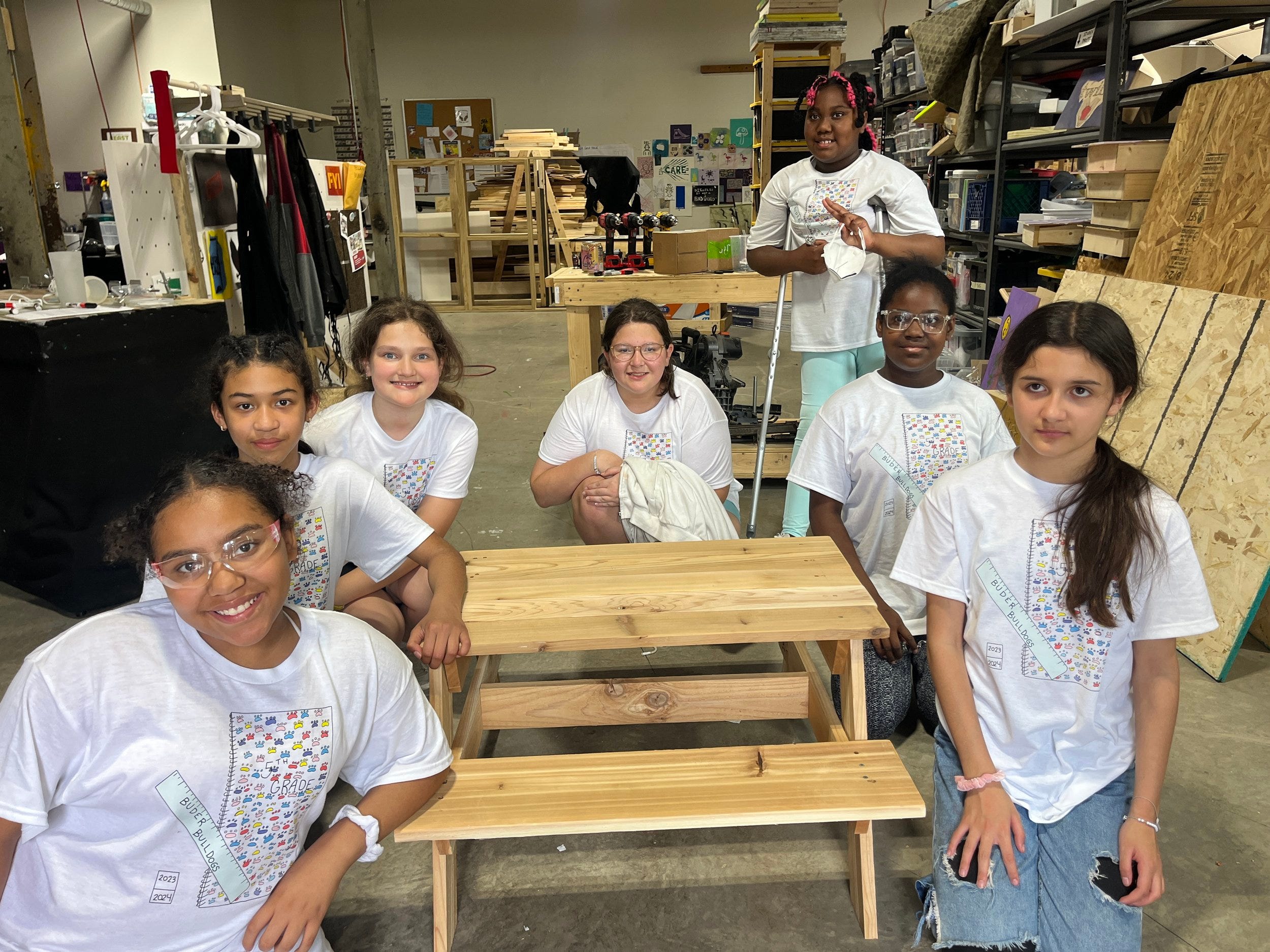
There are places that understand something essential about young people—that before you can ask them to master the world, you have to give them space to imagine it.
LitShop is one of those places.
Founded right here in St. Louis, LitShop is equal parts workshop and sanctuary—a space where adolescent girls* are not told who to be, but are invited to discover it for themselves. Not through abstraction. Not through theory. But through the deeply human acts of reading, writing, building, making, failing, trying again, and lifting one another along the way.
This is literacy as lived experience.
A story in one hand. A tool in the other.
In a 2,300-square-foot space in Botanical Heights, something powerful is happening every day. Girls are writing their own narratives while quite literally shaping the world around them—cutting wood, designing projects, solving problems that matter in their own communities. They are learning that their voices carry weight. That their ideas can take form. That collaboration is not just encouraged—it is expected.
And maybe most importantly, they are learning that they belong.
LitShop is intentionally built as an inclusive space, one that reflects the full spectrum of what it means to be a girl*. Cis, trans, non-binary, gender-expansive—this is a community where identity is not questioned, but honored. Where difference is not managed, but celebrated. Where young people can show up as they are and grow into who they are becoming.
Your support helps make that real in tangible ways:
Programs that blend literacy with hands-on building and design
A makerspace and woodshop where ideas become objects—and confidence follows
A literacy lab that fosters joyful reading, shared stories, and lifelong habits
A community of mentors and peers who model strength, care, and possibility
Expanded access to programming so more girls across St. Louis can participate
Growth toward full-time staffing to deepen and sustain the work
This is not enrichment for enrichment’s sake.
This is identity work.
This is confidence work.
This is the quiet, necessary work of ensuring that young people—especially those too often left at the margins—have the tools, the language, and the belief to shape their own futures.
LitShop is doing what education, at its best, has always been called to do:
not just prepare students for the world as it is—but equip them to build the world as it should be.
What this means for ANEW
Half of every paid ANEW subscription during this season will directly support LitShop—its programs, its space, and the girls it serves.
Please know this:
Supporting ANEW always means supporting children at promise—while sustaining the writing and extending its reach beyond the page.
If you’re already a paid subscriber, thank you. Truly. Your support makes this possible.
And if you’ve been reading quietly and wondering whether to step a little closer—this is an open door.
With gratitude,
Brian