
ANEW: Down in Devil’s Gulch
How a burlap dome in the middle of Marin County cracked me open and got me ready for the rest of my life


Kimberly had left for good.
I know that sounds like the kind of sentence people say with drama already baked into it. But the truth is flatter than that. She was gone. The house in San Anselmo was still there. The rent — eighteen hundred dollars a month — was still there. My half was nine hundred plus utilities, which was already a stretch on a teacher’s salary in Marin County. Her half was not coming. Neither was she.
Before she left, I had found the tapes. The ones she made with a psychic. And on those tapes, maybe a month before we split, the psychic said something that lodged in me like a splinter: There’s a baby out there in the ether that wants Brian to be his dad. I didn’t know what to do with that. I still rattles me to think about it all today. But I got in my car anyway.
I drove west.
That’s what I do when I’m lovesick. When I’m getting ready for it, or already deep in it, when the drip of loss has fully taken hold and everything gets crisp and unbearable and somehow more alive. I move. I drove out of San Anselmo and down Sir Francis Drake Boulevard, which is one of those roads that earns its name by being genuinely serpentine and genuinely beautiful and genuinely indifferent to your suffering. Past the high school also named after the pirate. Past the little package stores. Past the Buddhist retreat center that pulled hundreds of pilgrims off to the right. Past all of it, through the villages of Fairfax, Woodacre, and San Geronimo, and the little houses that sheltered hippies in their heyday, all stringing themselves along the road like people waiting for something to happen.
I was going to a sweat lodge. A woman named Shafia — Fia — had invited me. She was going through her own wreckage of a breakup with someone we worked with, and she had written her directions down meticulously. In the back of my mind, I thought maybe she would be the one. No matter. This felt like a spiritual journey of some kind, and I had learned not to argue with those.
When I found Devil’s Gulch, I understood immediately that I had been wrong about what I was headed toward. Fia wasn’t there. At least, I don’t remember that interaction at all. All I had was my grief, which felt like a fish tank strapped to the top of my head. Surrounded by something aqueous and dense.
In terms of the lodge, I had pictured a permanent structure. Something cathedral-like, or at least solid, the way church had been solid when I was growing up on the South Side — one day a week, one hour, everything explained and wrapped up before you were sent back out into the world. Preacher foaming at the mouth. You drank the juice and ate the cracker. And then you were gone. What I found instead was a small geodesic dome covered in burlap and moving blankets, tucked along one of the sleepiest coastal towns in Northern California. Point Reyes. Summer was just leaving. The leaves hadn’t made their full descent yet, but underfoot, they had already begun their own gathering.
A round in the lodge had just finished as I arrived. People were standing outside the flap, shivering in the cooling air, not particularly concerned that I had arrived overdressed and visibly lost.
“Welcome, Brother. Did you bring a pair of swimming trunks?”
I had, I nodded. In fact, I’d been told there would be sweating.
“Good. Because you are going to get mighty wet.”
I changed behind my car, wriggling into the dark blue trunks I’d bought at Sears near River Oaks Mall the last time I was back “home.” Where was “home” again? Was this new place, a year in, home again?
I came back from behind the car and joined them. Still shivering, they were trading stories outside the lodge — other sweats, other rounds, East Bay ceremonies, a few from Lakota lands in South Dakota. They cracked a few smiles at my obvious discomfort and me holding my towel like Linus’s blanket, but they didn’t make a project of me. They had their own heaviness to carry, not visible to me. It made me think of that Paul Simon line: the cross is in the ball park. We were all, each of us, somewhere in and around the weight of our own lives. Getting through it was the point.
Then the call came to go back in. My first time.
You enter a sweat lodge on your hands and knees. There is no other way in. I don’t think that’s an accident. Whatever you were outside — your job, your rent, your broken heart, your half of eighteen hundred dollars a month with no one to split it — none of it fits through that flap upright. You leave it at the opening. You crawl.
Inside, the darkness is total. When the water hit the rocks and the sage and the cedar, the heat works on your troubles like the namesake of the gulch we were in. Relentless. Cruel. Definitive. The searing heat and the dark and the singing penetrate you before your eyes or heart can adjust to anything, and they never really do. You find a place along the curved wall and you sit, and the rocks — the grandfathers, as the leader called them — glow faintly in the center pit, holding the intensity that had been building in them for hours outside over the fire. When the water goes on, the steam rises and fills everything and you understand in your body, not just your mind, that you are somewhere genuinely different from where you were ten minutes ago.
The chanting was not what I expected, either. I grew up in a gospel-y place. People “fell” out, but this was different than the cadence of the Black church. No sister’s “sanging” or your brother’s harmonizing with each other, rocking back and forth as if they would lift off somewhere while the rest of us stood by to catch them if they fell. This was older than that, even. It moved around the circle and found you, and you either joined it or you sat inside it, and both were acceptable. I mostly sat inside it. But I felt it working on me the way heat works — not asking permission, just entering. Every damned pore after every damned pour.
By the second round, I had stopped thinking about Kimberly. By the third round I had stopped thinking almost entirely. My head was almost touching the ground on my right side, ear to the ground. I could no longer mouth the imitation of the songs we were supposed to sing. I wanted to flee but every ounce of energy I had left willed me to stay.
That is when it happened.
The leader poured again. The steam surged. The chanting rose and the air became something you could almost hold in your hands, it was so dense and alive. And I felt myself beginning to separate from the ground I was nearly horizontal now on my haunches, like a felled animal. Buffalo, maybe? Not metaphorically. A sacrifice. My body was telling me, clearly and without ambiguity, that it wanted to move. Every rational thought I had left was saying: stay down, stay still, you are fine. But underneath that, something older and louder was rising. I wanted to get up off that ground. I wanted to crawl head-first across those rocks. Those molten, glowing, impossible rocks in the center of the circle. I wanted to go through something rather than just sit and endure it.
I did not crawl across the rocks. But I understood, for the first time, what people meant when they said they had left their body. I was hovering just above my own life, looking down at it. The house I couldn’t afford alone. The tapes. The psychic’s voice. The baby in the ether. Kimberly’s half of everything, which was now mine to carry. I could see all of it from slightly above, and from that distance it looked less like wreckage and more like a threshold.
I crawled out after the third round and sat in the cool evening air of the creek and did not speak for a long time.
The drive home on Sir Francis Drake was quiet in a way that had nothing to do with the road. I was different. Not fixed. Not healed in any clean or convenient sense. But reorganized in some way I couldn’t yet name, like a room where all the furniture had been moved two inches in every direction. The same room. New geography.
The psychic’s words came back to me somewhere between Fairfax and San Anselmo. A baby out there in the ether. A boy who wanted to call me dad. I didn’t know when. I didn’t know how. But somewhere between the heat of that lodge and the cool air opening up in front of me on the road home, I understood that I was being asked to get ready. Not for Kimberly’s return. Not for some other version of the same old story. For the second third of my life.
Father. Educator. Someone who shows up with some tools and without an instruction manual and does the work anyway. I didn’t know it yet in so many words. But I felt it. The lodge had done that. It had burned off just enough of the old story to make room.
And I have learned, slowly, over many years since, that feeling it first is almost always how the real things begin.
Curated Listening:
Because I listened to it over and over again after the lodge. Waiting for the boy. Waiting for the life. It filled many of the holes. Not all, but many. Next, she came. Then he came. Then she came. I played it at my first and only wedding. It was the first song. The one that we four danced to. First. Listen to Loggins and Messina sing Danny’s Song HERE.
Supporting = Loving
Thank you for walking with ANEW — an invitation
ANEW
If you’ve been here for any length of time, you already know this space was never meant to be fast or loud. It is meant to be attentive. Reflective. Human.
LitShop is here:
ANEW is a place to think out loud about education, leadership, creativity, memory, and what it means to keep becoming—together. My hope is that something here has helped you feel more awake to your own thinking, your own work, your own becoming.
As a gesture of thanks—and as a way to sustain this work—I’m offering a limited-time special rate on a paid ANEW subscription for readers who want to go a little deeper.
Redeem your special offer here →
What a paid ANEW subscription supports and unlocks:
Subscriber-only video essays and talks — longer, more personal reflections I don’t publish publicly, released every fourth Wednesday of each month.
Full archive access — the complete ANEW body of work, including curated listening and audio pieces.
Founding Members — a signed, personalized copy of my forthcoming novel, MANCHILD AT YALE (Fall 2026).
There’s one more thing that matters to say plainly.
Half of all paid subscription revenue continues to be directed to charitable causes—particularly those focused on children, education, and community well-being. That commitment isn’t new. It’s part of why ANEW exists.
For this season, we are proudly supporting:
LitShop — St. Louis, Missouri
DONATE NOW TO LITSHOP →
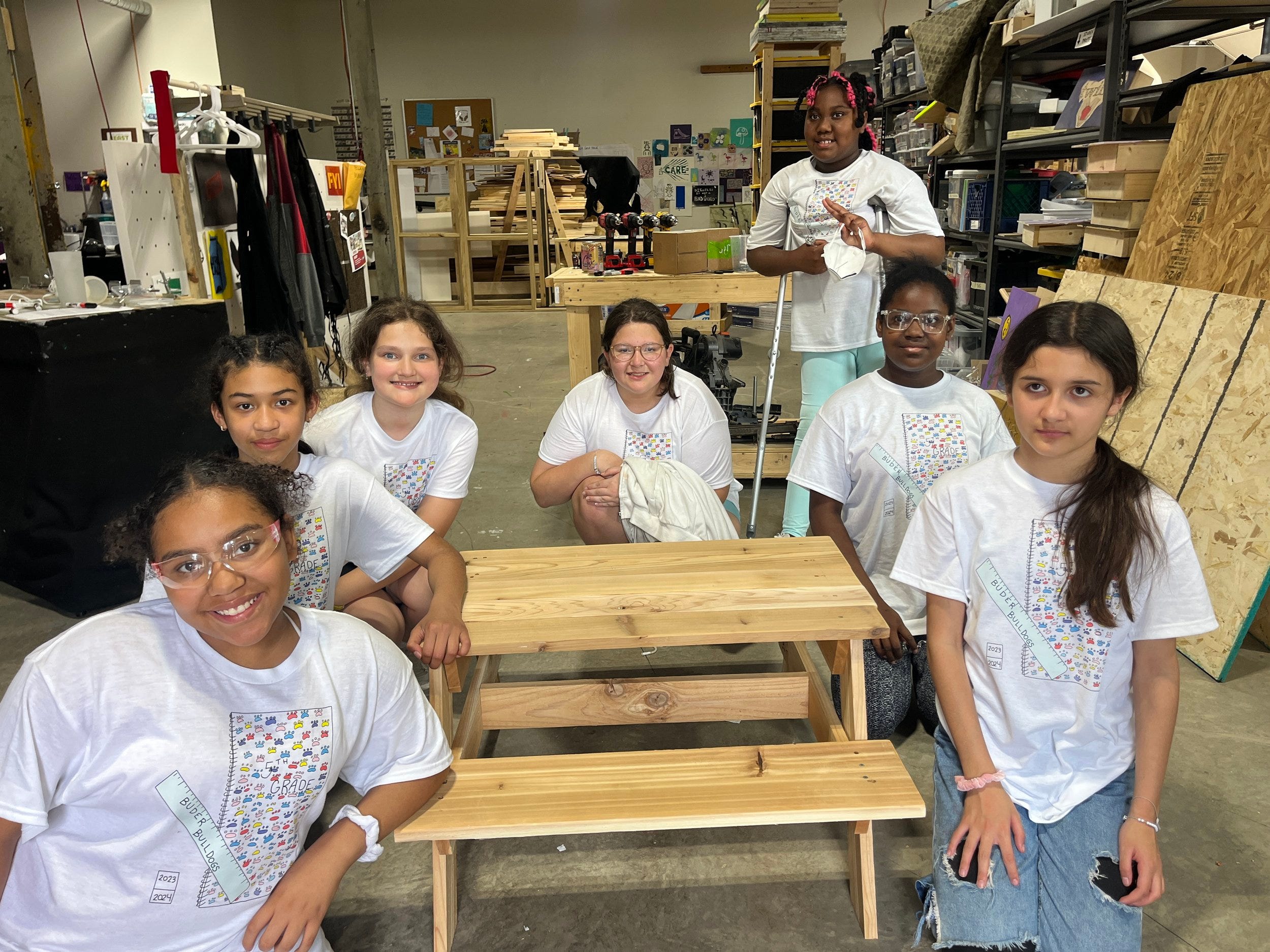
There are places that understand something essential about young people—that before you can ask them to master the world, you have to give them space to imagine it.
LitShop is one of those places.
Founded right here in St. Louis, LitShop is equal parts workshop and sanctuary—a space where adolescent girls* are not told who to be, but are invited to discover it for themselves. Not through abstraction. Not through theory. But through the deeply human acts of reading, writing, building, making, failing, trying again, and lifting one another along the way.
This is literacy as lived experience.
A story in one hand. A tool in the other.
In a 2,300-square-foot space in Botanical Heights, something powerful is happening every day. Girls are writing their own narratives while quite literally shaping the world around them—cutting wood, designing projects, solving problems that matter in their own communities. They are learning that their voices carry weight. That their ideas can take form. That collaboration is not just encouraged—it is expected.
And maybe most importantly, they are learning that they belong.
LitShop is intentionally built as an inclusive space, one that reflects the full spectrum of what it means to be a girl*. Cis, trans, non-binary, gender-expansive—this is a community where identity is not questioned, but honored. Where difference is not managed, but celebrated. Where young people can show up as they are and grow into who they are becoming.
Your support helps make that real in tangible ways:
Programs that blend literacy with hands-on building and design
A makerspace and woodshop where ideas become objects—and confidence follows
A literacy lab that fosters joyful reading, shared stories, and lifelong habits
A community of mentors and peers who model strength, care, and possibility
Expanded access to programming so more girls across St. Louis can participate
Growth toward full-time staffing to deepen and sustain the work
This is not enrichment for enrichment’s sake.
This is identity work.
This is confidence work.
This is the quiet, necessary work of ensuring that young people—especially those too often left at the margins—have the tools, the language, and the belief to shape their own futures.
LitShop is doing what education, at its best, has always been called to do:
not just prepare students for the world as it is—but equip them to build the world as it should be.
What this means for ANEW
Half of every paid ANEW subscription during this season will directly support LitShop—its programs, its space, and the girls it serves.
Please know this:
Supporting ANEW always means supporting children at promise—while sustaining the writing and extending its reach beyond the page.
If you’re already a paid subscriber, thank you. Truly. Your support makes this possible.
And if you’ve been reading quietly and wondering whether to step a little closer—this is an open door.
With gratitude,
Brian