
ANEW: Skates On
On falling down, getting up, and the particular joy of learning something new the hard way

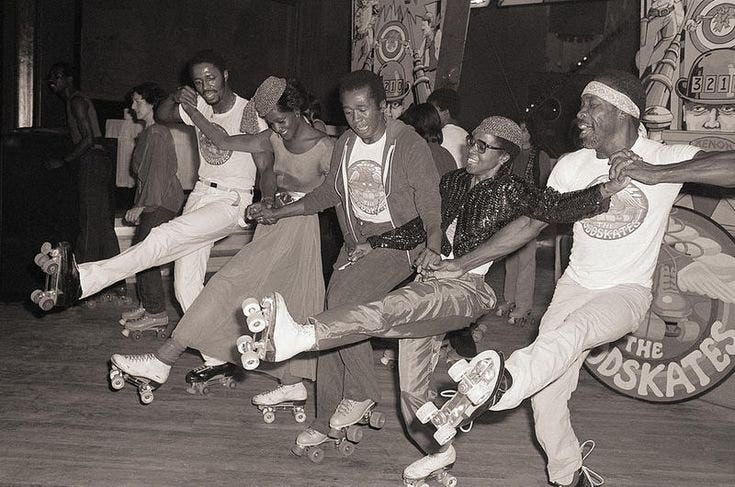
Way back when I had just gotten really comfortable with walking growing up in Robbins, Illinois, somebody decided to put us on skates.
This was not a moment in time when people skated on four wheels all in a row, which is what they call in-line skating. Most people skated either indoors, or if you were fancy, you had a pair of metal skates that you strapped to your feet that were really more like shoes with wheels that didn’t move all that well. In other words, those outdoor skates were mostly for comic relief. Because they didn’t.
But indoor skates were, in a word, torture. Especially in the beginning.
For our parents, the great thing about skating was that once a month — at some point in the fall, though I couldn’t tell you which part of the fall — it got us out of the house. My brother, who was four years older and roughly four years wiser and approximately four hundred percent cooler than I was, wanted very little to do with me when we went skating. Imagine strapping a thirty-five pound sack of brother to your wrist. That’s what I would have been to him. I never remember seeing him on my skating adventures, especially in the beginning. Yet somehow we both had to get there.
We woke up early, which is what little kids do. If you are six or seven years old, there is no such thing as sleeping in. On school week Saturdays, there were cartoons. But on skate days we didn’t think about books or bookbags. We thought about all of the yummy goodness that we were going to get at Art’s Roll-Aire Rink.
Art’s Roll-Aire Rink was not in our town. It was, at this point in our existence, two towns over. In Harvey, Illinois. Which meant, in the geography of childhood, that it was basically the moon. We loaded onto a bus in front of the house — forty or fifty kids, our little money folded in our pockets — and we rode the forty-minute trip across the South Side of Chicago like we were going somewhere. Because we were.
The moon, if it were dark and glowing and filled with hardwood floors and people moving on wheels, would look something like Art’s.
Guiding this particular space mission was our cousin Mabel, who was older, maybe even older than our mother it seemed, and very serious about the kids in her care having a good time. She was not an educator, so she did not regulate by fear or intimidation or anything that looked like a rubric. What she said was essentially, ‘if anything happens, I’m telling your mothers.’ For some of us, that was the most terrifying sentence in the English language. For others, it was a challenge. We said: yeah.
When we got there, the first stop was the counter, where the people who worked there had Lysol cans lined up to spray inside the rental skates before and after you touched them. You told them your size, because you had to know what it was, and then you walked on your blade-stiff feet toward the floor.
The floor was daunting. It was daunting to think about, and it was daunting to actually stand on. You laced up, you stood, and then you spent a substantial portion of your first three trips just holding onto the wall like it was the one true thing.
And maybe it was.
Because out there in the middle of the floor, people were doing things that looked impossible. Twirling. Skating backwards. Skating with somebody else, which was its own advanced curriculum. There was a way to lock the wheels so your skates became blocky shoes — blocky shoes with wheels — which was where some of us started. Others were adept enough that their wheels were loose, ball bearings and all. The skate key, which was not a key at all but a kind of wrench you used to tighten or loosen the whole apparatus, was the most important object in the building that I never had.
In our minds, we were Roll Bounce. In reality, we were very careful not to hurt ourselves.
Our friend Topper, now, he was a daredevil. He gave us something to look at on those days when looking was the best we could do. Some people provide inspiration by doing the thing beautifully. Others inspire you by their complete willingness to eat the floor and get back up. Topper was the latter, and we loved him for it.
But here is the real truth about Art’s Roll-Aire: the most important thing that happened there was not on the floor.
It was the hamburgers. The absolutely, impossibly, almost-translucently thin hamburgers, and the french fries that came with them, eaten in the little area off to the side after your ankles had given out and your pride had taken enough of a beating for one afternoon. The food was not good in any technical sense. But it tasted like everything, because it came at the end of something you had actually tried.
That is what skating was. Not a sport, not a class, not a lesson — just a thing you tried until you could do a little more of it. A way to be a kid among other kids, in a room built for exactly that, with a cousin watching from a distance making sure nobody died.
We were incredible then. Turns out, we still are.
May it always be so.
Curated Listening:
The magic of roller skating indoors is watching people who spent time perfecting their groove. You can positively feel the energy of the rink and those artisans of the boogie as they “roll bounce” their way into our hearts. Listen and watch Vaughan Mason & Crew as they Bounce, Rock, Skate, Roll HERE.
Supporting = Loving
Thank you for walking with ANEW — an invitation
ANEW
If you’ve been here for any length of time, you already know this space was never meant to be fast or loud. It is meant to be attentive. Reflective. Human.
LitShop is here:
ANEW is a place to think out loud about education, leadership, creativity, memory, and what it means to keep becoming—together. My hope is that something here has helped you feel more awake to your own thinking, your own work, your own becoming.
As a gesture of thanks—and as a way to sustain this work—I’m offering a limited-time special rate on a paid ANEW subscription for readers who want to go a little deeper.
Redeem your special offer here →
What a paid ANEW subscription supports and unlocks:
Subscriber-only video essays and talks — longer, more personal reflections I don’t publish publicly, released every fourth Wednesday of each month.
Full archive access — the complete ANEW body of work, including curated listening and audio pieces.
Founding Members — a signed, personalized copy of my forthcoming novel, MANCHILD AT YALE (Fall 2026).
There’s one more thing that matters to say plainly.
Half of all paid subscription revenue continues to be directed to charitable causes—particularly those focused on children, education, and community well-being. That commitment isn’t new. It’s part of why ANEW exists.
For this season, we are proudly supporting:
LitShop — St. Louis, Missouri
DONATE NOW TO LITSHOP →
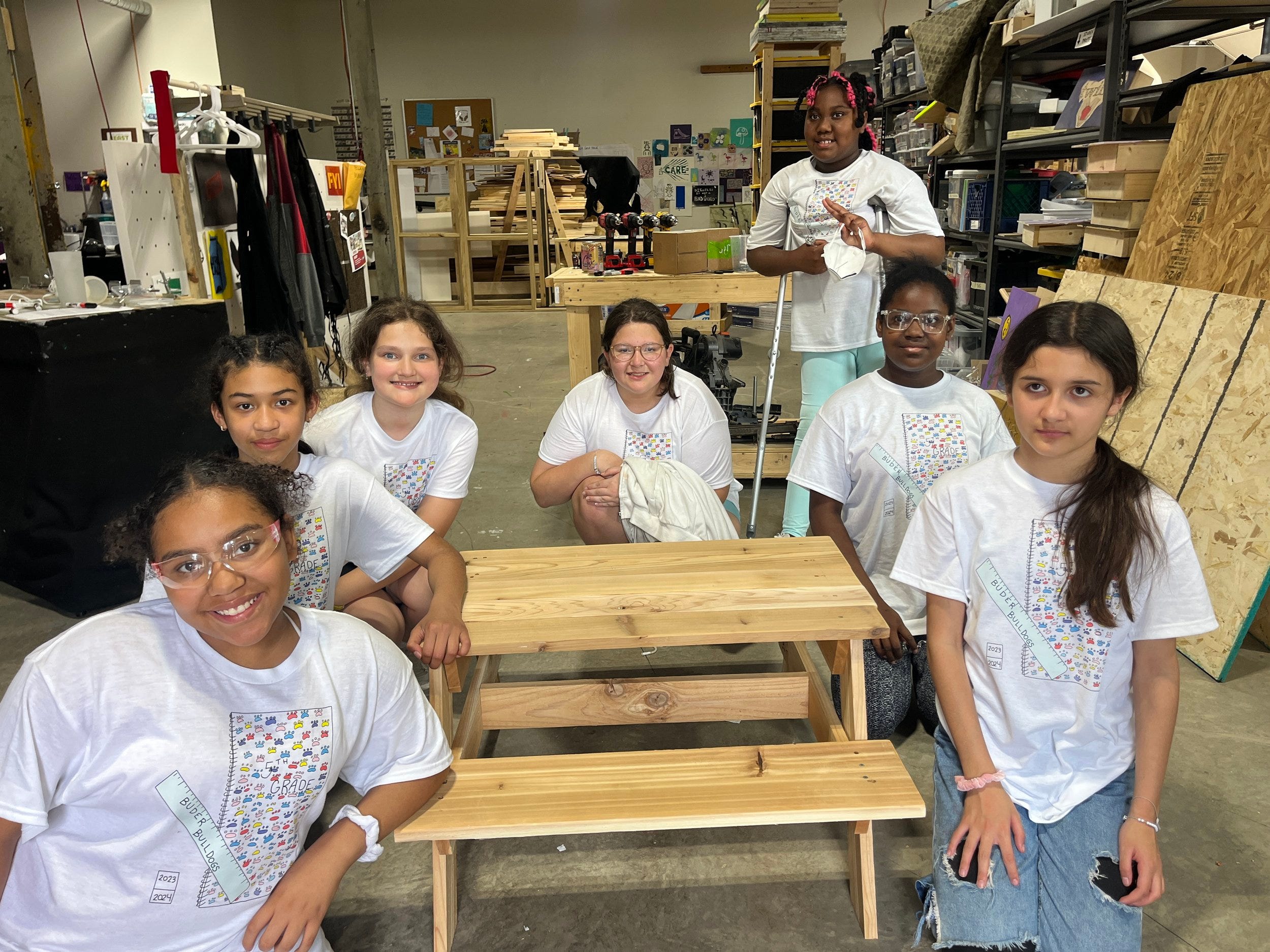
There are places that understand something essential about young people—that before you can ask them to master the world, you have to give them space to imagine it.
LitShop is one of those places.
Founded right here in St. Louis, LitShop is equal parts workshop and sanctuary—a space where adolescent girls* are not told who to be, but are invited to discover it for themselves. Not through abstraction. Not through theory. But through the deeply human acts of reading, writing, building, making, failing, trying again, and lifting one another along the way.
This is literacy as lived experience.
A story in one hand. A tool in the other.
In a 2,300-square-foot space in Botanical Heights, something powerful is happening every day. Girls are writing their own narratives while quite literally shaping the world around them—cutting wood, designing projects, solving problems that matter in their own communities. They are learning that their voices carry weight. That their ideas can take form. That collaboration is not just encouraged—it is expected.
And maybe most importantly, they are learning that they belong.
LitShop is intentionally built as an inclusive space, one that reflects the full spectrum of what it means to be a girl*. Cis, trans, non-binary, gender-expansive—this is a community where identity is not questioned, but honored. Where difference is not managed, but celebrated. Where young people can show up as they are and grow into who they are becoming.
Your support helps make that real in tangible ways:
Programs that blend literacy with hands-on building and design
A makerspace and woodshop where ideas become objects—and confidence follows
A literacy lab that fosters joyful reading, shared stories, and lifelong habits
A community of mentors and peers who model strength, care, and possibility
Expanded access to programming so more girls across St. Louis can participate
Growth toward full-time staffing to deepen and sustain the work
This is not enrichment for enrichment’s sake.
This is identity work.
This is confidence work.
This is the quiet, necessary work of ensuring that young people—especially those too often left at the margins—have the tools, the language, and the belief to shape their own futures.
LitShop is doing what education, at its best, has always been called to do:
not just prepare students for the world as it is—but equip them to build the world as it should be.
What this means for ANEW
Half of every paid ANEW subscription during this season will directly support LitShop—its programs, its space, and the girls it serves.
Please know this:
Supporting ANEW always means supporting children at promise—while sustaining the writing and extending its reach beyond the page.
If you’re already a paid subscriber, thank you. Truly. Your support makes this possible.
And if you’ve been reading quietly and wondering whether to step a little closer—this is an open door.
With gratitude,
Brian
Oh! The roller rinks of yore!!! Unforgettable birthday hauling twelve ten year olds in my mother's convertible Olds in Cincy. The days when we moved our bodies because it was full of joy, not because we had to balance the time at a desk with a workout. Do kids of today have that sense of moving out of joy? Or is everything scheduled?