

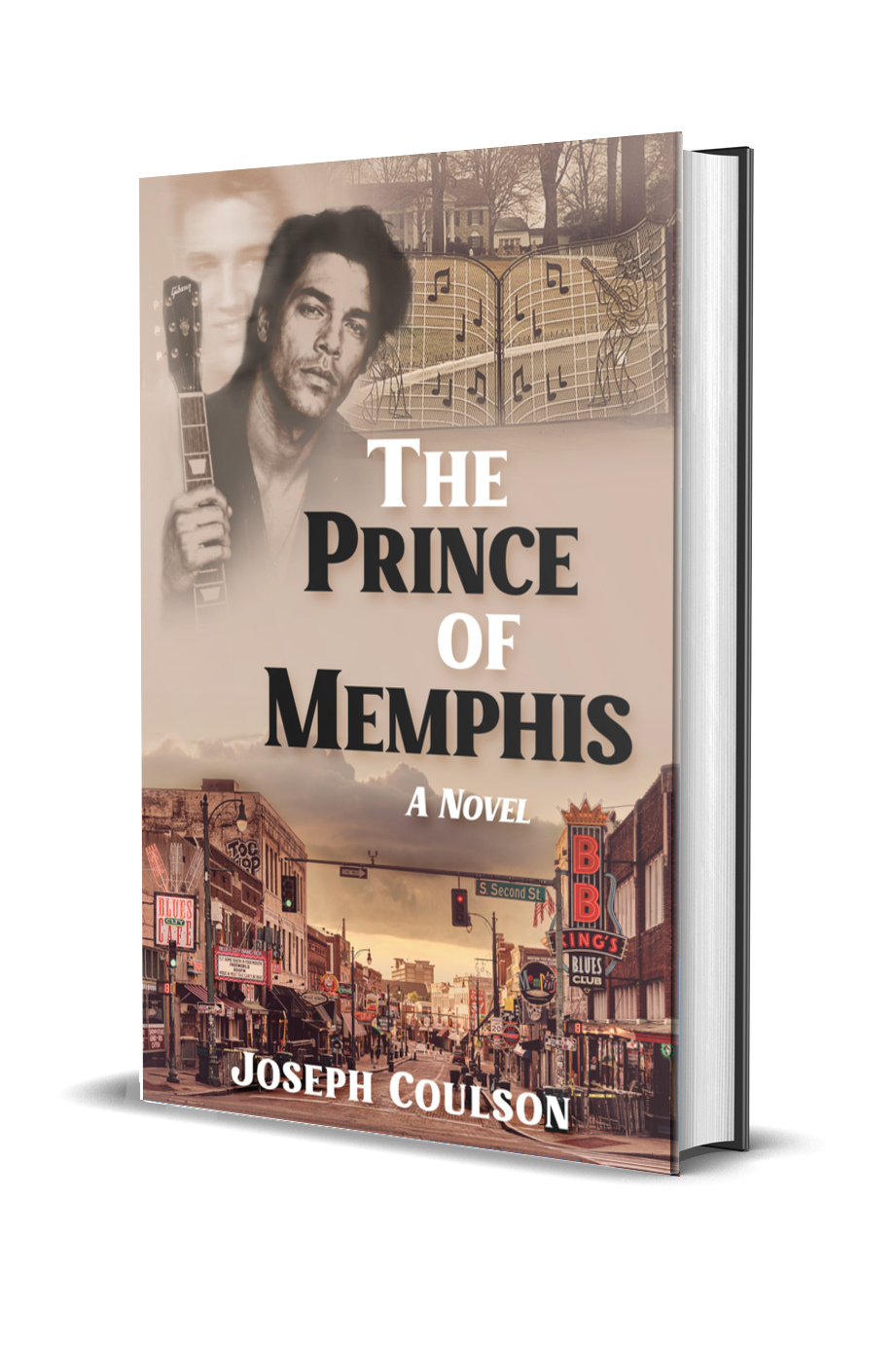
How many novels come with a killer soundtrack? Not many. The Prince of Memphis does.
You can hear it on nearly every page of Joseph Coulson’s new novel: gospel and jazz, rhythm and blues, the rockabilly swagger that rose out of Tupelo and Memphis and changed the sound of a nation. But the music is not decoration. It’s soul in a bottle. It’s also the entire superstructure of a keening, Promethean work of fiction that often hits bedrock on its journey, singing and bleeding to be seen. It is how this book breathes, how it remembers, how it grieves.
Aron Beale is the unacknowledged son of Elvis Presley, growing up in Detroit. He knows who his father is. Whether his father knows who he is remains the open wound at the center of the story. That uncertainty is the engine of the novel, and Coulson drives it with crisp dialogue, a sharp intelligence, and a sentence-level wit that kept stopping me cold. It’s the kind of repartee that Raymond Chandler and Raymond Carver would have written if they were frenemies. In TPM, a character looks “like Beethoven on a bender.” An encounter is “like being groped by a guy with good manners.” You laugh, and then you realize you have just been handed the book’s whole moral weather and guiding ethos in a single line.
Because menace in this novel rarely arrives shouting. It arrives with manners. Mr. P. Grimes, the book’s antagonist, embodies what Coulson calls the power of polite disregard, the quiet, courteous cruelty that can do more damage than any fist. And underneath it runs something even more corrosive: jealousy. It pervades the book like humidity in a Memphis August.
Consider an early scene in which young Aron is taken out on a raft by an older, meaner boy: that grimy and grim Grimes. Anyone who has read Huckleberry Finn feels the echo immediately. The water, the raft, the drift, the long afternoon. It begins as something almost pastoral. And then it turns. I won’t say how. I will say that it is the inverse of Huck and Jim on the Mississippi. Where Twain’s raft becomes a fragile sanctuary, Coulson’s vehicle becomes a stage for threat and resentment. It is a remarkable piece of writing, and it tells you early that this author knows exactly which American myths he is wrestling with.
Then there is Byron Moon, a character who seems to have stepped out of legend and into a nightclub. Coulson invokes the famous line once spoken about his namesake, Lord Byron: “mad, bad, and dangerous to know.” It fits. Byron Moon is charisma and catastrophe in a single suit.
And there is Odelia, Aron’s love interest, who is whip-smart and seems to live with one foot in the jazz age and the other in some world just past this one. She sees Aron more clearly than he sees himself. “You don’t believe in future,” she tells him. “There’s no working forward for you.” It reads like a diagnosis. It also reads like prophecy.
At Aron’s mother’s funeral, the mourners sing “Take My Hand, Precious Lord.” For a reader who grew up on the South Side of Chicago, that hymn carries freight. Thomas A. Dorsey wrote it in grief. Dr. King asked for it on the last night of his life, in Memphis. Elvis recorded it too. In Coulson’s hands, the song becomes a kind of harmony line running beneath the whole novel, connecting Black sorrow and white longing, the sacred and the profane, the church and the stage.
That harmony matters, because the book does not look away from what threatens it. Midway through, death threats surface that echo the ones made against Dr. King, Malcolm X, and Medgar Evers. They are threats of harm, yes. But they are also something older and more patient: the determination to keep something from flowering in the next generation — thank you, Bob Marley. Coulson understands that America has always been especially afraid of what its children and poets might become.
There is a moment I keep returning to. Aron goes to Marriott’s Great America on the very day Elvis dies. The king is gone, and his son is standing in an amusement park named for a country it can only imitate. “I was out of style,” Aron says of himself, “before I even started.” It is funny. It is devastating. It is the whole American inheritance in eleven words. I, too, went to one of the Great America Amusement Parks on the day that Dr. King’s mother was murdered in Atlanta. She, too, was playing the organ at Ebenezer Baptist Church, probably a song that Elvis would have known well.
The Prince of Memphis is a novel in the company of Heart of Darkness, of The Great Gatsby, of Huckleberry Finn. I don’t say that lightly. It belongs not only among great American novels, but among great novels, full stop. It is myth and legend rolled into one, and it is smart in the way the best books are smart: not showy, but knowing.
What Coulson knows is this. America sometimes feels like a freak show. But it is ours. Elvis embodied that contradiction. He took the music of Black churches and juke joints and Southern porches, jammed it together with country and pop, and sold it back to a country that never quite admitted where it came from. It couldn’t. It still can’t. To make Elvis’s son the protagonist is to name the second generation of that inheritance. And in many ways, we are all Elvis’s son. Black and white and brown, jammed together, unacknowledged, still waiting to find out whether the father knows our name.
The Prince of Memphis is beautiful. It is also unsettling, and it should be. In the absolute beauty of this world, Coulson reminds us, there are things that can be true, that must be true, and that are already written into whatever comes next.
Read it. Then listen to it. It will sing back.
May it always be so.
Curated Listening:
Aron Beale had a song that was a hit in his day and before his father died. Imagine that. A fictional character with a yowling, howling voice of this last century. And it was a hit. Listen to Elvis Presley’s unacknowledged fictional son, Aron Beale, sing Midnight Candy HERE.
ANEW’S NEW CADENCE
Joseph Coulson’s The Prince of Memphis asks a question ANEW keeps circling back to: what do we inherit that no one ever told us about? Aron Beale knows Elvis is his father. Whether Elvis knows Aron exists is another matter. I recently wrote about discovering that my grandfather, Curt, attended what is now Langston University, a fact that quietly overturned the family story that my brother and I were the first to go to college. And not long ago I arrived a week early to Reverend Clyde White’s funeral at Trinity United Church of Christ, only to find myself among strangers mourning someone else, singing the same hymns we would sing for him. Lineage is like that. It doesn’t always announce itself. Sometimes it arrives on a raft, or in a funeral hymn, or in a song you’ve known your whole life without knowing where it came from.
Those stories have a way of talking to each other. So starting now, ANEW will talk with you more often.
Six days a week. New essays every Sunday, Tuesday, and Friday. The day after each one, on Monday, Thursday, and Saturday, a podcast episode where I take that essay off the page and into the room, with the digressions, the backstory, and the things that didn’t fit. And on Wednesdays, something special for paid subscribers.
This week begins with Coulson’s novel, a book about that very kind of inheritance. It comes with a killer soundtrack. I hope you’ll listen along.
May it always be so.
Supporting = Loving
Thank you for walking with ANEW — an invitation

If you’ve been here for any length of time, you already know this space was never meant to be fast or loud. It is meant to be attentive. Reflective. Human.
ANEW is a place to think out loud about education, leadership, creativity, memory, and what it means to keep becoming — together. My hope is that something here has helped you feel more awake to your own thinking, your own work, your own becoming.
As a gesture of thanks — and as a way to sustain this work — I’m offering a limited-time special rate on a paid ANEW subscription for readers who want to go a little deeper.
Redeem your special offer here →
What a paid ANEW subscription supports and unlocks:
Subscriber-only video essays and talks — longer, more personal reflections I don’t publish publicly, released every fourth Wednesday of each month.
Full archive access — the complete ANEW body of work, including curated listening and audio pieces.
Founding Members — a signed, personalized copy of my forthcoming novel, MANCHILD AT YALE (Winter of 2027).
Please know this:
Supporting ANEW always means supporting children at promise — while sustaining the writing and extending its reach beyond the page.
If you’re already a paid subscriber, thank you. Truly. Your support makes this possible.
And if you’ve been reading quietly and wondering whether to step a little closer — this is an open door.
With gratitude,
Brian